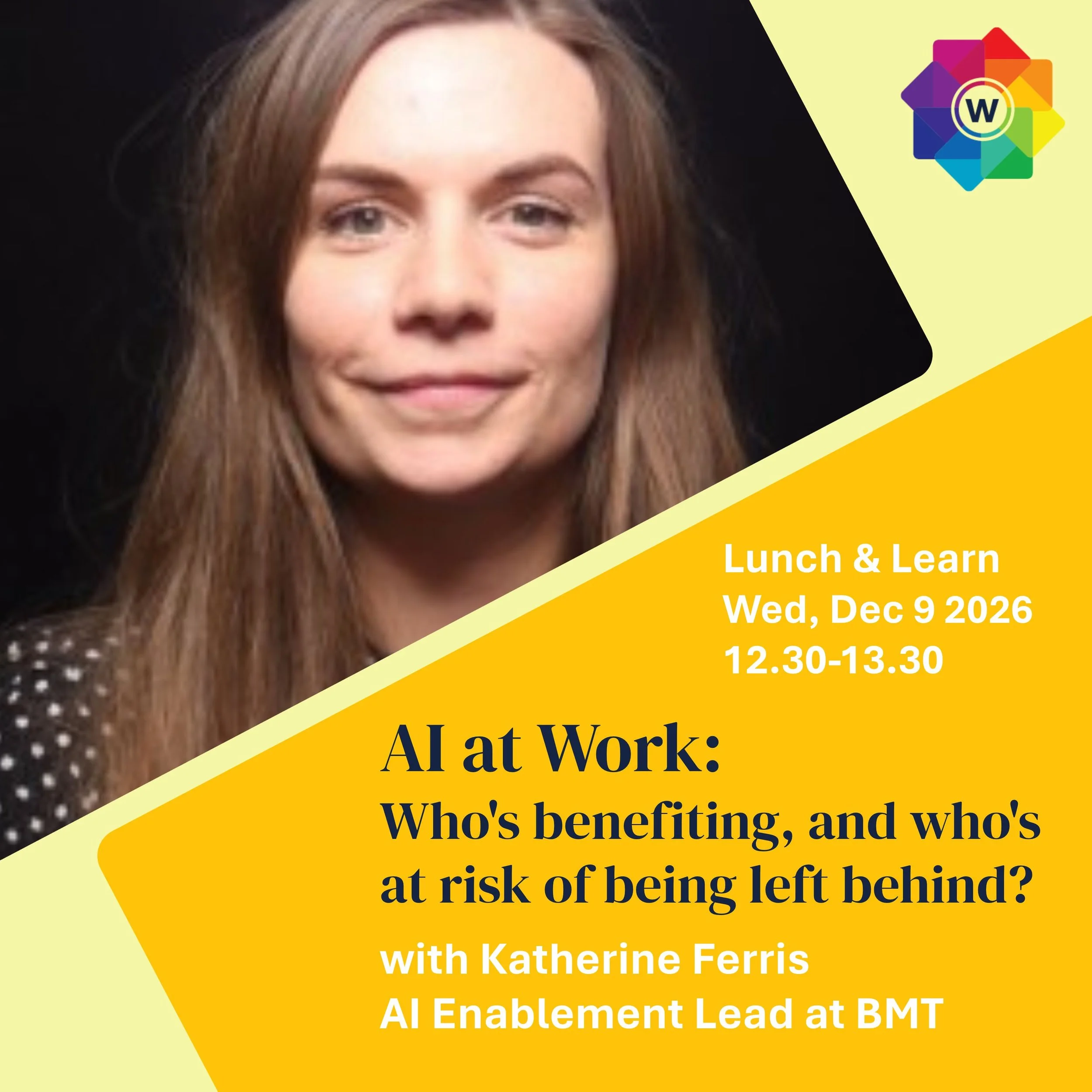
Q&A with Katherine Ferris
On Wednesday 9 December, Katherine Ferris, AI Enablement Lead at BMT, joins us for our lunch and learn session, AI at Work: How Do We Make Sure Everyone Benefits?
Ahead of the session, we asked Katherine about who is gaining from AI right now, what it means for women in the workplace, and what employers can do to bring their whole workforce with them.
Women in Business Charter (WiBC): There's a lot of talk about AI making work better for everyone. From what you've seen, who is actually benefiting at the moment, and who is in danger of being left behind?
Katherine Ferris (KF): There's a difference between personal and business productivity. Over the past two years, the focus has largely been on making people's day-to-day work a little more efficient, but the shift now is towards how teams and wider business processes can benefit.
The companies seeing the greatest value are those actively leaning in, investing in transformation, thoughtfully redesigning work and reskilling their teams, so that AI does what it's good at and people do what they're good at. Those most at risk of being left behind are people who are unclear about the ambition for AI and why their organisation wants to use it.
WiBC: What are the specific ways AI could support women in the workplace, and where do you see it creating new challenges for them?
KF: I've seen AI support women with promotions and alternative career pathways by helping them articulate their successes, or surface achievements they might not naturally call out themselves.
At the same time, AI could significantly change or replace aspects of administratively heavy roles, many of which are disproportionately held by women. That raises a much bigger question about reskilling, and how organisations plan for those changes so that the benefits of AI are shared more widely.
WiBC: Confidence comes up a lot when people talk about AI. Why do you think some people hold back from using these tools, and what helps them get started?
KF: One theme I've noticed recently is permission. Some employees, particularly women, can feel they need explicit permission from senior leaders to use AI without feeling as though they're ‘cheating’ or taking a shortcut.
That suggests confidence isn't only about knowing how to use the technology. It's also about creating a culture where people feel that using it appropriately is legitimate and encouraged.
WiBC: If an employer wanted to get AI adoption right for their whole workforce, not just a keen few, what would be the first two or three things you'd advise them to do?
KF: First, senior leaders need to agree why they want to embrace AI and what outcomes they're trying to achieve. They then need to communicate that clearly, so employees understand the bigger picture and feel psychologically safe using it.
Second, organisations need clear guardrails around what AI should and shouldn't be used for.
Finally, employees need the time and space to experiment, be curious and make mistakes. Leaders can reinforce this by making AI part of regular conversations with their teams, rather than treating adoption as a one-off initiative.
WiBC: What's one thing you hope people will take away from the session on 9 December?
KF: I hope people come away understanding both sides of AI adoption: the potential benefits for organisations and employees, such as increased productivity and wellbeing, but also the pitfalls when employees feel disconnected from senior leaders' AI ambitions.
Getting the technology right matters, but bringing people with you matters just as much.
Join us on 9 December
AI at Work: How Do We Make Sure Everyone Benefits? takes place on Wednesday 9 December. Book your place here, and share it with colleagues who are working out what AI means for their teams.