Women make up 41.7% of the workforce, yet only 24.6% of C-suite roles and 19.1% of CEOs. Progress on closing that gap grew steadily between 2015 and 2022.
These World Economic Forum statistics look good a first glance but since then the same reporting shows that progress has stalled.
If leadership capabilities are shifting toward empathy, adaptability and trust-building, why are promotion decisions still defaulting to subjective ideas of ‘presence’ and ‘gravitas’
That question sat at the heart of Women in Leadership: Making Talent Visible, a webinar hosted earlier this month by Edgecumbe Consulting. Sophie Mattholie, Edgecumbe’s Leadership Consultant, shared research on how leadership behaviours are perceived at an individual level.
Our director, Kristal McNamara, joined as guest speaker to look at the other half of the picture: the organisational systems that decide who gets seen and who gets promoted.
There is no shortage of conversation about women in leadership right now. But conversation and action are not the same thing, and every organisation is still grappling with this in its own way. Leaders are not a homogenous group, and neither are the barriers standing in their way.
Progress has stalled, not reversed
The shape of the trend is what makes it revealing. The WEF showing that between 2015 and 2022, there was steady growth in women entering senior leadership, an expansion of C-suite roles, a strong organisational focus on diversity and inclusion, and favourable economic conditions.
Since 2022, all four of those tailwinds have faded. Progress has plateaued, fewer new executive roles are being created, DEI has slipped down the priority list, and economic uncertainty and restructuring have made organisations more cautious about who they promote.
Where the pipeline actually leaks
The challenge is not attracting women in. It is retaining and progressing them. The pipeline runs from 41.7% of the global workforce, to 29.6% of top management roles, 24.6% of C-suite positions and 19.1% of CEO roles.
The leak is not at the top. It’s in the middle.
Middle management is where women are quietly leaving the race to senior leadership, often for reasons that never show up cleanly in an exit interview.
Four structural barriers keep the gap in place:
Narrow career pathways: CEOs are still mostly selected from a small set of traditional feeder roles.
Networks and sponsorship: women tend to have smaller professional networks and fewer senior connections.
The care penalty: women are significantly more likely to take career breaks and caregiving leave.
Evaluation systems: potential is often judged through subjective ideas of fit, presence and style.
The bias hiding inside ‘presence’
That last barrier is where a lot of quiet damage is done. Leadership is still unconsciously linked to masculine traits, a bias known as ‘Think Manager, Think Male’, so women can seem less ‘leader-like’ by default.
Social Role Theory adds another layer: women are expected to be caring and collaborative, while leaders are expected to be assertive and decisive. The result is a double bind. Collaborative can be read as weak, yet assertive can be read as unlikeable. There is no clean way to win.
‘Lean In’ thinking has its limits too. It encourages women to adapt to existing norms, but overlooks the organisational barriers that sit around them.
What the data says about women’s leadership
This was the part we found most striking, because it flips the usual narrative. Edgecumbe’s Primary Colours® 360 research, drawn from around 48,000 colleague responses between 2012 and 2025, found that women were rated slightly higher than men across all items (5.56 versus 5.48 on a 7-point scale). Both male and female colleagues rated female leaders highly, with female raters only slightly more generous.
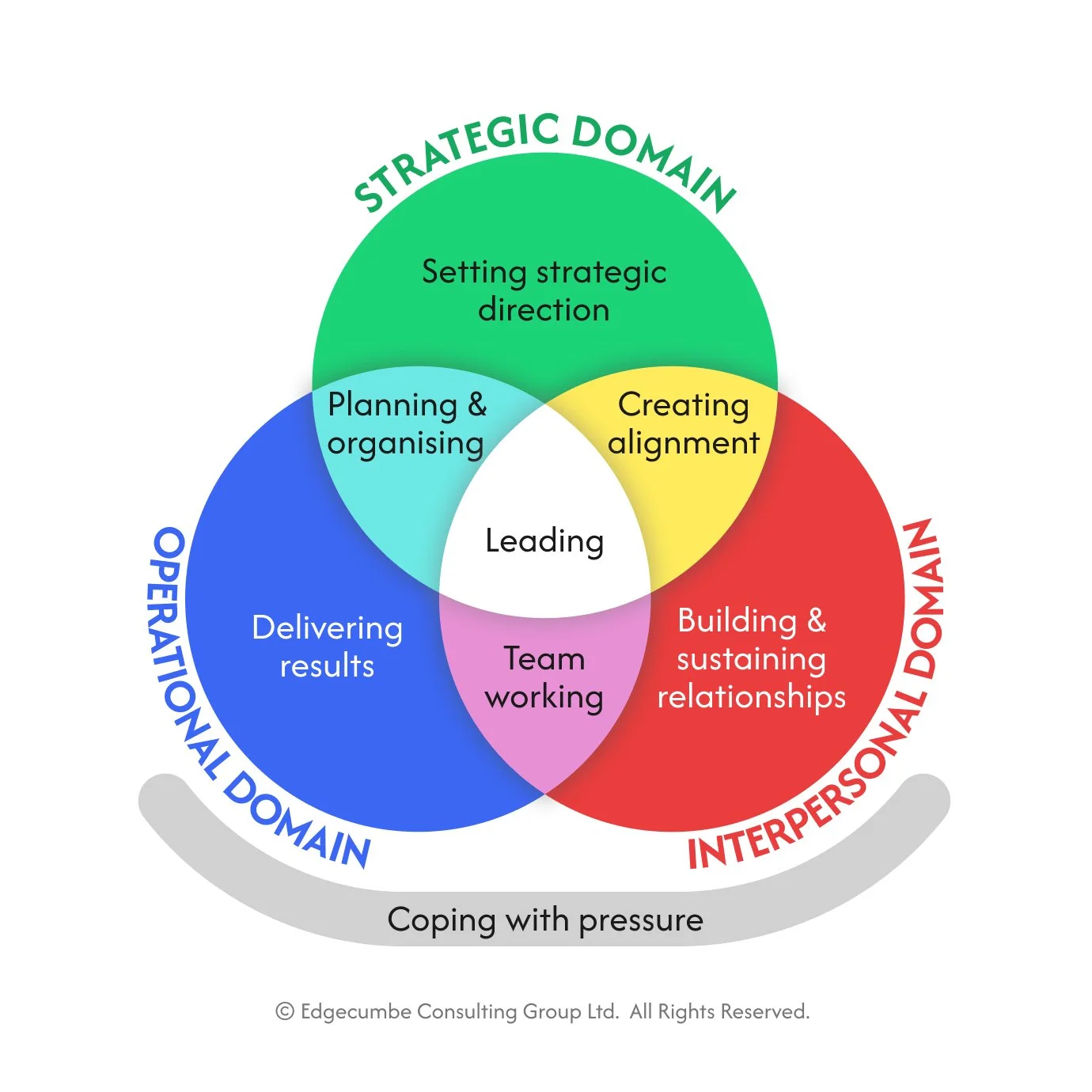
Women were rated higher on six of the eight leadership tasks, with the largest gaps in planning and organising, delivering results, team working, and building and sustaining relationships. There was no reliable difference in setting strategic direction, and men were rated very slightly higher only on coping with pressure.
The items where women scored highest are telling: demonstrating commitment to values, serving the team, making time for people, providing feedback, keeping everyone informed and involving people in decisions.
These closely match what Edgecumbe’s engagement research says successful leaders practice regularly: giving recognition, coaching, providing clear feedback, trusting and encouraging autonomy. Women leaders are well placed to build engaged teams and so lift performance.
Yet women rated their own leadership significantly lower than their colleagues did, by 0.39 points on average, compared with 0.24 points for men. Both are modest about their own leadership. Women are significantly more so.
That gap, between how women lead and how women see themselves leading, is exactly where storytelling matters. It is not about teaching women to perform confidence. It is about closing the distance between the evidence and their own self-perception.
Fixing the system, not the women
This is where Kristal’s contribution came in, and her message was direct: making talent visible is not about fixing women. It is about fixing the progression pathways, metrics and governance that assess them.
Edgecumbe’s research points to four pillars for redesigning leadership systems: redefine capabilities around future-fit skills rather than traditional career paths, rewire power pathways through wider access to sponsorship and networks, build fair and structured selection, and redesign conditions with flexible, inclusive careers and better support for caregiving and re-entry.
Across our network, Women in Business Charter Signatories are showing what that looks like in practice:
Governance over goodwill: Rise Technical Recruitment made female progression metrics a permanent monthly board agenda item under Managing Director sponsorship, while Bristol City Council uses Charter reporting as a formal governance tool across directorates.
Active sponsorship: Triodos Bank UK pairs mid-level women with C-suite sponsors through its RISE Programme, and UWE Bristol combines sponsorship with targeted funding to advance racially minoritised academics.
Objective progression: Avon & Somerset Police established structured pathways and executive sponsorship to achieve a 75% female promotion success rate to Chief Inspector.
Flexibility by design: Wessex Water embeds senior flexible working and evaluates leaders on measurable outcomes rather than presenteeism, to stop mid-career talent loss.
Five practical shifts for people leaders
Audit intersectional data: track exactly where people drop off across levels, and hold leaders accountable for it.
Sponsor proactively: identify high-potential talent and run focused, unbiased succession planning, rather than relying on self-nomination.
De-bias selection: use structured competency assessments to measure capability over subjective “presence.”
Train managers as coaches: foster the psychological safety that surfaces the quiet capability directive styles overlook.
Default to flexibility: design senior roles with flexibility built in to protect retention.
The evidence suggests that women don’t need fixing – leadership systems do.
Our thanks to the Edgecumbe team for the collaboration and to our signatories for driving meaningful change across our region.